
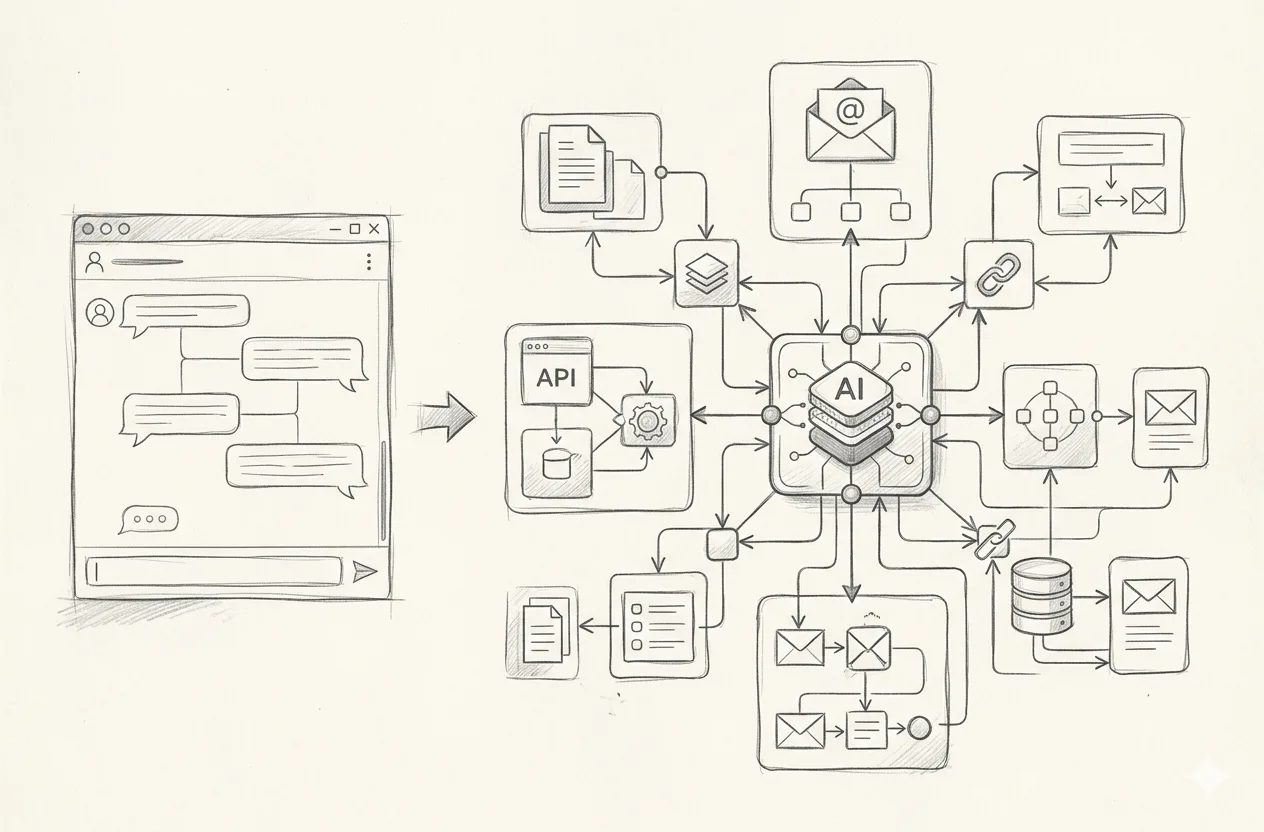
Not long ago, the market was playing around with AI chats at scale.
Put simply, if a website had a little window that could reply in something vaguely resembling human language, it was already being presented as “AI implementation.”
It sounded modern.
It looked decent in a presentation.
Some people even got excited.
But in real business, one simple thing became obvious pretty quickly: an AI chat is not automation yet. It is just a conversation interface. Sometimes useful. Sometimes nice-looking. Sometimes even fairly decent at answering typical questions. But between “having a nice conversation” and “executing part of a real business process,” there is a gap where many polished SaaS solutions quietly lose their credibility.
That is exactly why businesses are moving from simple AI chats to AI agents for business processes. Not to bots that speak nicely. But to systems that actually do things:
- validate data,
- work with internal services,
- trigger logic,
- operate according to company rules,
- hand the user off to another scenario or another agent,
- send emails,
- call specific APIs in sequence,
- check conditions and drive the task to a concrete result.
Where an AI Chat Ends and an AI Agent Begins
An AI chat usually answers questions. In a better case, it consults. In an even better case, it helps a person avoid getting lost on a website. That is already useful. But if we are being honest, in most cases it is still a digital conversationalist, not a digital operator.
An AI agent for business processes is a different structure altogether. Its job is not just to keep a conversation going, but to guide a person or an internal process through a specific scenario with rules, validations, transitions, and actions.
If we put it in plain English, the difference is simple:
- An AI chat answers questions.
- An AI agent executes logic, performs actions within a process, and answers questions when needed.

And this is where it gets interesting. In a real company, tasks almost never come down to “reply nicely.” What a company needs is a system that works within a specific operational logic. And that is already a completely different architectural level.
Why Businesses Need More Than Just a “Smart Bot”
The problem with most boxed solutions is not that they are bad. The problem is that they are usually good only until the process remains typical, simple, and not too deeply embedded in the real operational machinery of a company.
And then real life begins.
A company has its own rules. Its own tables. Its own fields. Its own statuses. Its own exceptions. Its own approval routes. Its own internal services. Its own strange legacy decisions that nobody loves but everybody has to live with. And this is exactly where it becomes obvious that real AI agents for business processes cannot be built as a universal SaaS box “for everyone.”
Because a business process is not a template from a landing page or some book about “1488 steps to insane success.” It is a living system with conditions, roles, validations, and accountability. If an agent cannot work inside that logic, it remains just a talkative layer sitting on top of chaos.
What an AI Agent Can Actually Do Inside a Company
This is exactly where the line is drawn between “oh, now we have a bot” and “we now have a working digital agent.”
In a real business, an agent can do far more than just talk. It can execute scenarios like these:
- analyze schedules or other specific files according to internal company rules;
- validate user-provided data and reconcile it with CRM, ERP, or other systems;
- send an intermediate verification code by email or to a smartphone to continue the dialogue or confirm an action;
- hand the user off to another agent or another flow with separate instructions and logic depending on certain conditions;
- call API methods depending on validation results or algorithm conditions;
- create requests, bookings, appointments, internal notifications, or emails;
- work with multi-step scenarios where what matters is not one answer, but the full route to the final action;
- and plenty of other things that would be hard to fully invent just for one article.

And here is the key idea: the value of an agent is not that it can speak nicely. Its value is that it can become part of a controlled process and help people by taking routine work off their shoulders.
Why a Good Agent Often Has Less Than 10% Actual AI
Many people do not love this part because it slightly ruins the magical picture. But the truth is that in serious agent-based solutions, the amount of “pure AI” may be just 10%. Sometimes even less. And sometimes a process can work almost without AI at all.
Because if you break a good agent into components, the structure usually looks something like this:
- business logic,
- rules and constraints,
- integrations with internal systems,
- checks and validations,
- routing between scenarios and roles,
- security and access control,
- logging, monitoring, and error control,
- decision-making algorithms,
- and only on top of all that — a language model that helps interact with a human normally.
So yes, AI is needed here. But not as a circus act and not as magic dust sprinkled over an old process in the hope of enlightenment. It is needed as one component of a system where everything critical rests not on model improvisation, but on a well-designed architecture.
And that, by the way, is a sign of a mature approach. When a company does not try to dump responsibility onto a “smart model,” but instead builds an environment in which the agent can operate in a controlled way.
Why the SaaS Box Almost Always Hits a Ceiling
A boxed solution is good when you need to start quickly with something basic. FAQ. Simple consultations. Standard lead capture. A straightforward dialogue without too many exceptions. And that is perfectly fine.
But real business almost never lives only in that mode.
As soon as you need to:
- work with non-standard files or specific data structures,
- build multi-step branching logic,
- perform verification through email, code, or an internal system,
- split scenarios across multiple agents,
- execute conditional API calls,
- adapt behavior to the rules of a specific company,
- maintain control over process, security, and scaling,
— the boxed approach starts to fall apart. Not because “the developers are bad.” But because the box itself was never designed for the real, unique process of a specific business.

And this is where many companies make the core mistake: they try to squeeze a living business process into someone else’s box instead of designing a system around their own needs.
Why Google Cloud Architecture Is Especially Strong Here
If we talk practically, the strength of Google Cloud is not that “it has one more model.” The real strength is that on Google Cloud you can build not just a chat, but a full microservices architecture for company business processes.
In other words, not “a bot for the sake of having a bot,” but a system where you can combine:
- Gemini / Vertex AI for the language layer and context handling;
- Agent Orchestration for complex scenarios;
- Cloud Run and server-side logic for controlled actions;
- API integrations with internal and external systems;
- work with files, knowledge bases, RAG, and specific data sources;
- routing between agents and different flows;
- monitoring, logging, scaling, and enterprise-grade security;
- and plenty of other useful components.
And this is no longer a story about “one more bot on a website.” This is a story about how a digital agent starts operating inside the real operational contour of a company.
The Business Does Not Adapt to the Agent. The Agent Adapts to the Business
This is probably the main point of the whole topic.

In the weak scenario, a company buys a boxed AI tool and then painfully tries to figure out how to stretch its process over it.
In the strong scenario, everything works the other way around: first, the business process itself is analyzed — its logic, validations, roles, data, risk points, and automation points. Only after that is an agent system designed and embedded into that process.
That is why strong AI agents for business processes are not “a marketing add-on.” They are already an element of a company’s operational architecture.
What This Means for Business in Practice
In practice, this means something very simple, though not always pleasant: the era of AI chats as a self-sufficient answer is gradually coming to an end.
Yes, a chat can still be useful. As a front layer. As an entry point. As an interaction interface. But the real value appears where there is an agent system behind that interface — one that:
- does not just talk, but executes,
- does not just promise automation, but actually removes workload from people,
- does not live separately from the business, but embeds into its processes,
- does not fantasize instead of following rules, but works inside controlled logic.
Conclusion
The shift from simple AI chats to AI agents is not a fashion trend and not just a pretty change in terminology. It is a natural mature stage in the development of the market.
Business no longer needs a system that merely supports a dialogue. Business needs an agent that can become part of real work: validating, triggering, reconciling, handing off, confirming, executing scenarios, and driving an action to its final result.
And this is exactly where the difference becomes visible — where demonstrational AI ends and real company digital infrastructure begins.
The future does not belong to bots that simply talk nicely. The future belongs to AI agents for business processes that know how to be not a showpiece, but a working business tool.
FAQ: AI Agents for Business Processes in Brief
What is the difference between an AI agent and an AI chat?
An AI chat mainly answers questions. An AI agent not only supports dialogue but also executes actions within a business process: validating data, triggering logic, calling APIs, handing a user off to another flow, or producing a result in an internal system.
Can you build a serious AI agent on a SaaS box?
For basic scenarios, sometimes yes. For deeper processes with non-standard rules, files, validations, integrations, and multi-step logic, usually no. In those cases, a custom architecture is almost always required.
Why can AI be only 10% of an AI agent?
Because the real value is often created not by model responses, but by rules, algorithms, integrations, validations, routing, and execution control. The model is only one component of a much larger system.
What business tasks are AI agents suitable for?
They are suitable for support, sales, bookings, lead qualification, document workflows, data validation, internal scenario execution, CRM/ERP-based request handling, and many other processes where logic, rules, and repeatable actions are involved.